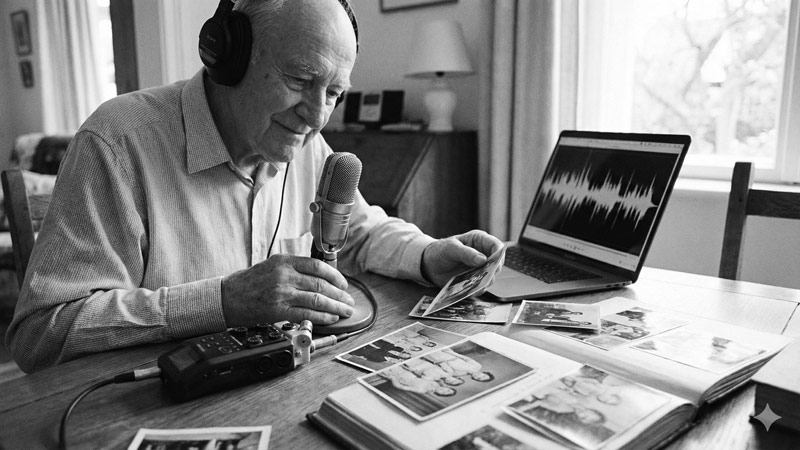
We have all done it. You open an old, dusty photo album, flip through the pages, and smile at the faces of loved ones who have passed on. You see their eyes, their style of dress, and the setting of a family holiday from thirty years ago.
But as you stare at the image, you might find yourself trying to remember something specific. You strain to recall the sound of their laughter. You try to replay the way they told a joke, or the specific soothing tone they used when you were upset.
A photograph captures a moment in time, but it is silent.
At Voiced Legacy, we believe that while a picture is worth a thousand words, the sound of a loved one’s voice is priceless. It turns out, science agrees.
There is a distinct biological reason why hearing an old recording feels more “real” than looking at an old picture.
Visual memory and auditory memory are processed in different parts of the brain. Visuals are processed in the visual cortex, but sounds are processed in the auditory cortex, which has a much more direct highway to the limbic system—specifically the amygdala and the hippocampus.
These are the parts of the brain responsible for immediate emotional processing and long-term memory storage.
This is why you can look at a photo of your wedding day and remember facts (where it was, who was there), but hearing the song that played during your first dance can instantly make you feel the way you felt in that moment.
When we rely solely on photos to preserve a legacy, we lose the “texture” of a personality. The human voice carries an immense amount of data that a camera lens simply cannot catch:
When you lose the voice, you lose a massive part of the person’s essence. As time passes, the memory of a voice is often the first thing to fade, which is what makes preserving it so vital.
We understand that you don’t want to choose between seeing and hearing. That is why our “Family Chronicle” and “Definitive Legacy” packages are designed to capture the complete picture.
By conducting professional, filmed interviews and creating the Cinematic Portrait Film, we capture the sparkle in the eye and the crack in the voice. We capture the gesture of the hands and the belly laugh that follows a funny story.
We are not just recording history; we are preserving the “soundtrack” of a life.
If you have a parent or grandparent whose stories are currently stored only in their memory, consider the value of capturing them now. A photograph will show future generations what they looked like, but a Voiced Legacy interview will teach them who they were.
Are you ready to capture the full story? Contact us today to book your session.